
NextNW Expert Panel Interview: AI in Advertising & Marketing

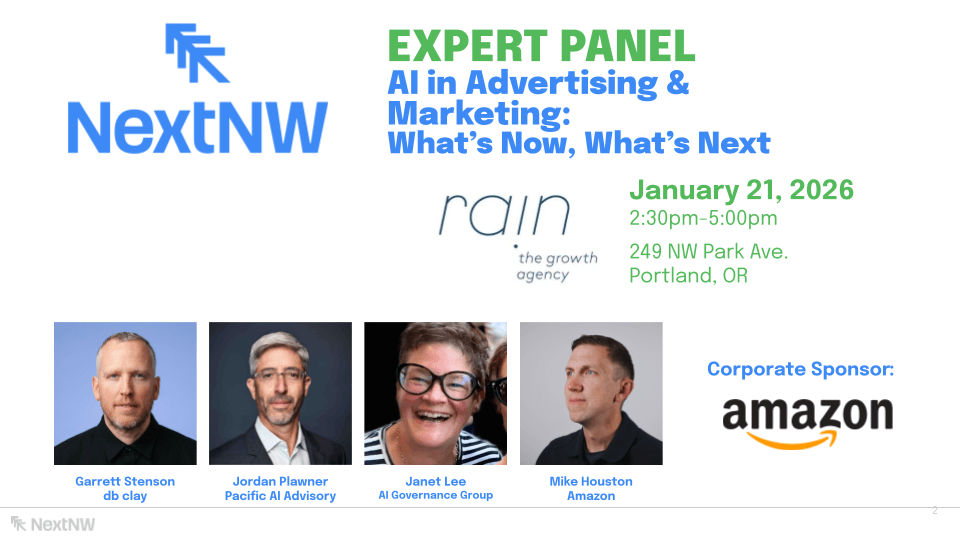
On January 21st, 2026, NextNW hosted a panel of AI experts and asked a host of questions from the advertising, marketing and creative industry perspective. Our seasoned panelists included Mike Houston, Janet Lee Johnson, Jordan Plawner, and Garett Stenson. A summary of their answers to our questions are below.
How do you see AI impacting the advertising & marketing industry in the next 2 years?
Janet: We’re in the middle of an AI Supercycle, and marketing won’t be spared the transformation. The agencies and brands that treat AI as merely an efficiency play will get left behind. The real winners will be those who pair AI capabilities with distinctly human skills, like empathy, critical thinking, storytelling instincts. Expect AI to handle more of the production work while humans focus on strategy, trust-building, and the nuanced creative decisions machines simply can’t make. And if you’re selling into or serving clients in the EU, the August 2026 AI Literacy mandate is coming whether you’re ready or not.
Mike: I have a friend who says don’t trust anyone who sounds too confident and I proudly maintain I have no idea where stuff is headed. But a reason I keep being hopeful is I keep experiencing opportunities to bring MORE creativity into the world. Now that its such a light lift to execute something reasonably well, I’m able to do so many things I wished I had the ability to do before. An example: we had an Amazon team event at Climate Pledge Arena, and when we found out we had access to the jumbotrons, we made a bunch of AI videos of Amazon employees as, like, NBA players dunking and doing weird AI things that played all around the arena. It was epic. We would have never had a budget for this in the past, but we had videos on ALL the monitors. I also feel like people get less upset about you taking on crazier stuff because there’s less at stake.
Jordan: What I don’t think will work is living in just one loop. If you only run the inner loop—everyone playing with tools on their own—you get a tiny productivity bump but almost no real transformation. If you only run the outer loop—bolting AI on at the organizational level like a horseless carriage—you get sameness and low ROI, because the underlying workflows and metrics haven’t changed. Where I see real impact is treating AI as coordination glue across strategy, creative, media, and data. The bottleneck moves from ‘who knows what’ to ‘who can orchestrate, who can hold risk, who can exercise judgment.’ Dynamic creative, smart bidding, and personalization will just be the plumbing everyone has. The inner loop is about literacy and workflow hacks; the outer loop is about redesigning processes, tying AI to clear KPIs, and putting governance around it so that it actually shows up in the business, not just in individual hacks.
Garett: At a high level, here’s where I’m coming from. I’m sitting on my back deck on a sunny but cold Saturday in PDX, so take this FWIW. I believe agency and marketing leaders will need to fundamentally unlearn and relearn nearly everything they once knew. Take your decades-old playbook and throw it out the window! We’re heading into a period of real transformation across workflows, org structures, service models, pricing strategies, accelerating timelines, client expectations, and customer behavior. New everything. This isn’t meant to be alarmist, and I could be wrong, but the ground is clearly shifting beneath us and things are about to get wild.
What are the activities and outputs you’ve been most surprised to see AI make possible over the past year?
Mike: I was shocked recently that Claude was able to nail humor on a recent radio campaign. We had this campaign talking about the quirky people in your life you buy gifts for—very Real Men of Genius style. Just an announcer voice with really witty writing. We made a little AI application to take the writer’s original 3 scripts and clone them into a campaign with 30 scripts. And some of the scripts were hilarious. This was a case where the writer actually liked that AI was making spots because it was just extending their idea to more ideas.
Janet: Honestly? AI as a tutor and thinking partner. Discovering prompts that turn AI into a genuine learning companion, not just answering questions but pushing you to think deeper. The other surprise is how quickly AI has become embedded in tools we already use. More than two-thirds of SaaS applications now have AI features baked in, often without meaningful notification. That speed of “integration” caught even me off guard (most integrations are peanut-buttered in, but grabbing more and more data).
Jordan: What doesn’t surprise me anymore is the one-shot, ‘prompt-and-pray’ stuff. A clever prompt screenshot is not a strategy. Tool-hopping from one shiny app to another without a system also doesn’t move the needle. What has surprised me is how fast multi-step, multi-tool workflows have become practical, and how early agents are starting to look like a workflow operating system. You can now ask AI not just for an answer, but to act as a thinking partner: ‘Before you answer, what else should I be asking you?’ It can take a messy deck or a long email trail and semantically align it into a coherent plan in one pass. And with what I’d call digital twins—tools that learn your style, your brand, your patterns—you start to feel like you’re collaborating with a partner that actually understands your context over time.
What are the easiest ways to get started integrating AI into workflow and processes?
Janet: Start with curiosity, not a massive technology rollout. Pick one pain point… something repetitive or time-consuming, and experiment. Use AI to draft, to summarize, to brainstorm. The process teaches more than the product, as I’ve learned. Know that you’ll discover as much from the failures and iterations as from the final output. The key is building AI literacy across your team so everyone understands what these tools can and can’t do.
Mike: The way my group got started—we had an internal AI conference and we knew it’d be great to open with a video. But AI video was terrible. This was the era of Will Smith eating spaghetti. So we made a video, of that caliber, with a deepfake Jeff Bezos who pronounced amazon Ermerzorn, and said it was our new Super Bowl spot. It was amazingly horrendous. But just going through the motions of making it actually taught us a surprising amount. I think just having a goal where you try to make something—an app, a video, a business document—even if that thing is terrible, you’ll learn. Then just do this for lots of things.
Jordan: What doesn’t work is saying, ‘Everyone go play with ChatGPT and report back,’ as if random experimentation will magically add up to strategy. The flip side also doesn’t work: a big top-down AI mandate layered on top of the same old workflow. The easy, practical start is a 90-day experiment with one workflow and one intact team. Map the steps, then deliberately give AI the repetitive, well-defined tasks first. In parallel, teach people to have better conversations with the tools—ask for critiques, ask for risks, ask for alternatives—so they’re using AI to think, not just to paste in prompts. While that inner loop is running, redesign one end-to-end process with AI built in from the start, and wrap it with a simple AI policy, brand guardrails, and a clear human-in-the-loop so people trust the results.
How can I leverage AI to expedite my career journey?
Garett: AI is poised to disrupt nearly every corner of the economy, from medicine to money to energy to manufacturing, not just the creative industry. And yet, what remains constant amid the chaos is simply being human. Curiosity. Meaning-making. Building real, quality relationships. Those things matter more than ever. So as a creative professional, a bunch of questions naturally come up. How do you differentiate yourself? What skills matter now? How do you expand your output and increase your wingspan? And on and on and on…. But these questions feel too tactical. I think what’s actually required is a deeper shift in mindset. AI isn’t just a tool. It’s a call to reimagine how we think about work, what we value, and why we exist. We probably need to sort that out before we worry too much about advertising better. Haha.
Jordan: What will not accelerate your career is using AI simply to crank out more low-purpose tasks faster. If you stay ‘below the algorithm’ as a task executor, you’re putting your identity exactly where the technology is strongest. So my identity and agency angle is: don’t define yourself by a skill that can be automated. Define yourself by the mission you’re on and the problems you own. AI then becomes a tool to get to that purpose faster, because it creates more time for strategy, creativity, and relationships. In practice, that means becoming an orchestrator. Map your team’s workflows, design how AI fits into them, and measure the impact. Be the AI-literate person who can talk about tools and business outcomes in the same sentence. And use AI as a coach: have it critique your writing, role-play stakeholders, and help you design learning plans. Those are the people who get pulled into more interesting rooms.
Mike: If you’re early in your career, this is the best moment. Nobody’s an expert. The playing field is level. I used to run our intern program and I couldn’t believe students didn’t have tons of AI work in their portfolios—you could be the best in the world at this right now, and you can put a portfolio together all by yourself. If you’re late in your career, you have a wealth of knowledge on how to direct a team of experts. You can now execute 10x what you used to. You have so much power. Nobody has taste like you.
Janet: As someone who built a 40-year tech career without a four-year degree, I believe that skills have always mattered more than credentials. AI amplifies that truth. Use AI to learn faster, to fill gaps in your knowledge, to practice skills you haven’t yet mastered. But don’t neglect the durable skills: curiosity, resilience, adaptability, tenacity, empathy, critical thinking, collaboration. These seven traits are what will separate people who thrive in the AI era from those who get displaced by it. Technology will never supersede humanity, but you have to cultivate and leverage your human strengths intentionally.
How can you use AI to enhance the creative process and storytelling?
Mike: We have this campaign called 5-Star Theater where actors read Amazon reviews. This year was Benedict Cumberbatch. Last year was Adam Driver. We actually had this idea like 4 years ago, but it fizzled out because we couldn’t find enough creative customer reviews for them to read. It wasn’t a problem of not having them—we have 2 billion reviews. But we had no way to find the good ones. This was like the perfect use case for AI. We built a tool we call StarSearch that went through customer reviews and looked for stories where an ordinary purchase turned into an extraordinary moment. And it worked. It found all these great stories, and those are what we have actors read. So if you’ve seen one of those spots, they were humans writing them, humans performing them, humans filming them. It was just AI helped us find them.
Janet: AI is a phenomenal collaborator for ideation and iteration. It can help you escape “local maxima” – those comfortable valleys where your thinking gets stuck. Sometimes progress means going backward first, trying something that feels foolish, like Dick Fosbury flopping over the high jump bar the “wrong” way. AI can push you toward unexpected combinations, challenge your assumptions, and accelerate the messy middle of creative work. But the soul of the story? The emotional truth? That stays human.
Jordan: What doesn’t work creatively is letting AI chase clicks for you and sliding into generic, lowest-common-denominator content. Treating prompts themselves as the creativity is a dead end. I like to think of AI as a divergence engine: it’s fantastic at giving you 20 directions, 50 headlines, 10 visual ideas. But then humans become the editors—the ones with taste and context. We can also use AI as a story translator, taking the same core narrative and expressing it differently for a CFO, a CMO, and a consumer. If AI handles a lot of the first-draft and versioning work, creatives can spend more time with clients, really understanding their fears, their aspirations, and what the brand should never say, even if it might perform. That’s where guardrails around meaning live, not just around performance.
What are the primary concerns agency owners and management should have relating to governance, risk, policy, and guardrails?
Janet: Shadow AI is already here, and it’s your biggest blind spot. Vendors are adding AI capabilities (and grabbing more data) to software you already own without your consent or meaningful notification. Your legal team *may* have reviewed the original contract years ago, but did anyone review last quarter’s terms of service update? Probably not. And here’s what keeps me up at night: your insurance likely won’t cover what’s coming. The trouble isn’t about AI itself. It’s about human behavior and organizational accountability. You need policies, playbooks, guidelines, and guardrails. Governance isn’t bureaucracy; it’s how you build trust, manage risk and avoid catastrophic exposure.
Mike: I’ve actually become very close collaborators with our legal team. They’re figuring all this out, just like we are. In general, a really shorthand takeaway is we’ve found it easier to go from one to many than from zero to one—like producing something the old-fashioned way and then cloning or scaling that. This is also good because legal always wants a paper trail of someone getting paid. If you have a human likeness, they want the actor it looks like. Visual style, same thing. This works better creatively in our experience as well.
Jordan: The governance anti-pattern is assuming, ‘Legal will write a 40-page AI policy and we’re done,’ or letting shadow AI use grow with no disclosure and no logging. Both are risky. At a minimum, you need human-in-the-loop as your core safety mechanism, especially for anything external. You need brand guardrails, not just brand guidelines, explicit boundaries on tone, claims, bias, and red-line topics that apply whether the content is human- or AI-generated. And you need a simple, living policy: which tools are approved, what you can and cannot do with client data, how escalation works, and how AI-assisted outputs are labeled. Underneath all of that is respect for human autonomy: no dark-pattern manipulation, no using these systems to push people in ways you wouldn’t be comfortable owning as a leader.
Once marketers have successfully adopted AI into the daily workflow, how do you see agencies evolving in the next 2-5 years?
Jordan: Agencies that shift from ‘we make things’ to ‘we make things work’ will be in a much stronger position. They’ll sell outcomes: growth, engagement, lifetime value, brand equity, not just deliverables. Their advantage will be orchestration: using AI as a coordination layer across data, creative, and media. The real differentiators become taste, novelty, and a willingness to hold risk. Taste is knowing what not to run, when to hold back, when to surprise. Novelty is bringing ideas that only this brand could execute at this moment. And experience is living with the consequences of real campaigns, not just generating options in a sandbox. So the line I’d leave for agency leaders is: if you define your agency by outputs, AI is a threat. If you define it by purpose by helping clients grow in distinctive, human ways, AI is a lever. For me, the real question isn’t ‘What will AI do to us?’ The real question is ‘What do we want to do with AI?’ If we define ourselves by mission and purpose, AI becomes a tool to accelerate the transition out of low-purpose work and into creativity, problem-solving, and more deeply human collaboration. That’s the opportunity that gets me excited, and that’s the conversation I think our industry needs to have.
Janet: The agencies that survive will look fundamentally different. I see a shift toward what I’ve called the “Organizational Mind, or O’Mind” concept. AI will continually and systematically seize organizational knowledge, capturing IP, and integrating human and AI-powered processes into a living intelligence that will last beyond employee departures. Agencies will compete less on production capacity and more on strategic insight, ethical leadership, and the ability to build trust with clients navigating an increasingly regulated landscape. The EU AI Act is foundational, but not finite. Those who treat governance as a competitive advantage – not a compliance burden – will own the future.
Garett: Things are about to start running downhill fast. We’re already seeing it. For example, the democratization of content creation at scale. People across HR, finance, and operations building micro apps with natural language. Synthetic avatars reshaping research. Agentic systems changing how commerce will work. Hyper-personalization at scale with near-zero marginal cost. Etc. Alongside all of that is a tangled mess of IP, ethics, and governance that’s going to trigger real societal backlash. None of this is clean or simple. And frankly, no one is prepared. Which is why the posture can’t be blind hype or fear-driven resistance. It has to be cautious optimism, anchored in a human-first mindset, as we figure out what this next chapter is actually asking of us.
Mike: 2-5 years is such a long time. I don’t even want to guess.
We hope you can join us at a future NextNW event. Become a member and save on every event and receive other benefits.


Responses